Spain Transport Minister Blames Traffic Controller in 69-Death Train Crash
Unions counter that outdated systems and understaffing caused the collision on the Madrid-Sevilla line, the second fatal accident on the route this year.
By Ricardo Kovalenko ·
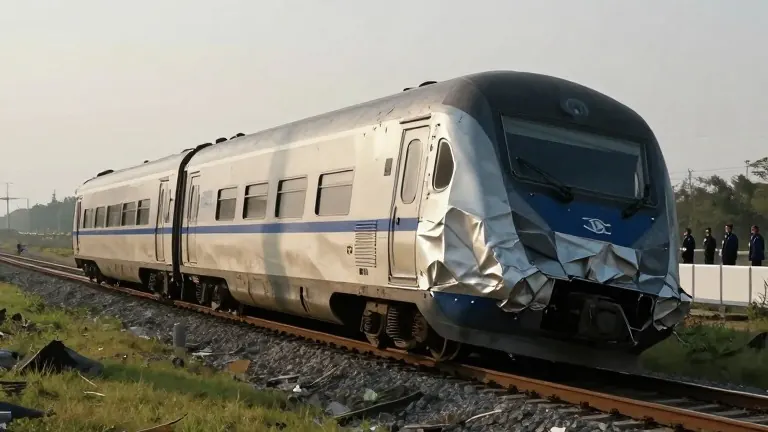
Sixty-nine people died in a high-speed train collision in the province of Toledo on Wednesday, marking the second major rail disaster in Spain in twelve months. Transport Minister Óscar Puente attributed the crash primarily to the judgment of a human traffic controller. He described the controller's decision to allow a train to resume speed while another remained stopped as inexplicable and erroneous. Puente stated in a press conference that a stop signal remained active on the line at the time of the error.
The incident occurred at 8:53 a.m. on the Madrid-Sevilla route. At 8:30 a.m., the line's LZB communication system failed. This system normally monitors train positions and can trigger automatic braking. Following the failure, human controllers in Madrid assumed responsibility for safety on a 63-kilometer stretch of track. Authorities believe six trains were present on that segment during the outage.
At 8:36, a controller instructed a state-owned RENFE train to return to normal speed. A private IRYO train, located 25 kilometers ahead, attempted to move but its driver could not override an automatic stop. The driver reported this issue to the control center. Independent investigators reported that the RENFE train was traveling between 160 and 200 kilometers per hour when it struck the IRYO train.
Railway unions reject the minister's focus on individual error. They point to deteriorating working conditions and a shortage of staff. The unions argue that controllers manage too much traffic for the current number of personnel. They note that the network carries 45 million passengers annually. Raquel Ayllón, spokesperson for the SCF union of traffic controllers, said the minister is blaming a worker facing worsening conditions. She stated that human error is not incomprehensible, but the regular failure of the safety system is.
Diego Martín, a spokesperson for the SEMAF union of train drivers, noted that the 30-year-old LZB system has failed repeatedly in the past. The system is being gradually retired but remains in use on this line. Martín said the system should have been replaced long ago. He added that it failed on Wednesday and has fallen out of service on multiple previous occasions.
The collision is the second fatal accident on this route this year. In January, a train derailed and struck an oncoming train more than two hours south of Madrid, killing 46 people. Spain's high-speed network is the second largest in the world after China's. It had not suffered a fatal accident in over three decades prior to this year. The government had previously considered the network a success of industrial policy.
Spain opened its high-speed rail market to private operators in 2021. Before that, only state-owned trains ran on the network. Both accidents this year involved one RENFE train and one IRYO train. Traffic increased after privatization. The SCF union reported that average daily trips between Madrid and Barcelona rose from 56 in 2019 to 89 in 2024. Joan Rodríguez, a spokesperson for the railway workers' union, said this increase in traffic placed additional pressure on the infrastructure.
A judge and a special government commission are conducting independent investigations into the crash. Prime Minister Pedro Sánchez promised to investigate the matter thoroughly. King Felipe VI visited injured passengers in a Toledo hospital on Thursday. He said the investigation must determine how and why the catastrophe occurred and what measures are needed to prevent a recurrence.
Investigators retrieved the trains' black boxes late Thursday and handed them to the Civil Guard. Police with search dogs examined the wreckage on Friday morning. Railway workers held a strike on Thursday to demand the government fulfill its commitments to improve safety conditions following the January accident. Union representatives criticized media outlets for leaking audio fragments of communications between the control room and drivers in the minutes before the crash.
Source: WSCV