Kremlin Signals Return to Three-Way Ukraine Peace Talks After St. Petersburg Summit
Russian President Vladimir Putin has agreed to restart negotiations with the U.S. and Ukraine in November, following a three-hour meeting with U.S. envoy Steve Witkoff that focused on postwar security and economic ties.
By Ricardo Kovalenko ·
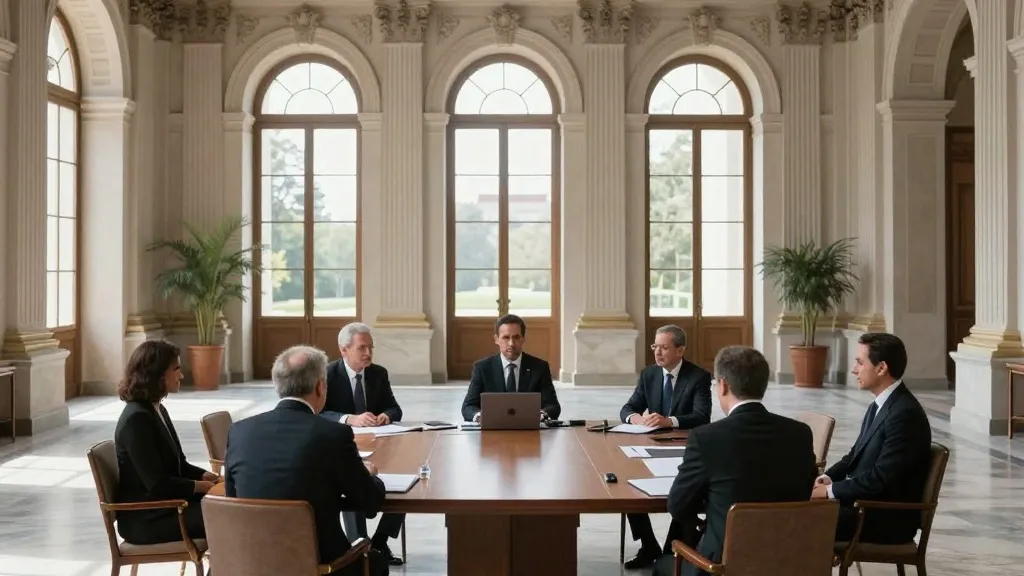
Russian President Vladimir Putin has agreed in principle to resume three-way negotiations with the United States and Ukraine, a development that could lead to the first such talks since February. The decision was announced by Kremlin foreign affairs adviser Yuri Ushakov following a significant meeting in St. Petersburg between Putin and U.S. envoy Steve Witkoff. The discussions are scheduled to take place after November 10, marking a potential shift in diplomatic momentum more than four and a half years into the conflict.
The primary focus of the upcoming talks will be establishing a security framework for both Russia and Ukraine once the conflict concludes, according to Ushakov. This agenda comes as U.S. President Donald Trump intensifies pressure on Kyiv to reach an agreement that halts the fighting. Ukrainian President Volodymyr Zelenskyy expressed support for the rapid restart of negotiations, stating in an audio message that the goal is to end the war and prepare for a meeting at the leaders' level. However, Zelenskyy noted a history of canceled meetings, saying, “Then something changed. Things were canceled. We’ll see what happens this time.”
The St. Petersburg discussions, which lasted approximately three hours, took place at the Constantine Palace. In addition to Putin, Ushakov, and Russian presidential envoy Kirill Dmitriev, Trump’s son-in-law Jared Kushner joined the conversation via video link. A U.S. official familiar with the private meeting indicated that Witkoff and Kushner proposed a technical-level three-way meeting and shared progress from their earlier discussions with Zelenskyy in Oslo. The group also reviewed a postwar economic plan and European security arrangements.
Despite the progress, the Kremlin maintained a cautious stance regarding recent proposals. Ushakov stated that the proposals emerging from the previous day’s meeting in Oslo, where Witkoff met with Zelenskyy and European leaders, contained “little of real value” in resolving the crisis. While Moscow is not “fully satisfied,” Ushakov told Russian state television that the Oslo outcomes represent a step in the right direction. This sentiment aligns with the broader assessment that previous efforts by the Trump administration to end the war have made limited significant progress.
Beyond the immediate peace talks, the leaders discussed broader bilateral relationships. Putin indicated readiness to consider restoring U.S.-Russia economic ties and to discuss the U.S.-led conflict in Iran, suggesting Moscow could use its relationship with Tehran to aid peace efforts. Ushakov highlighted that “large-scale joint economic projects” were discussed in detail, with some nearing the implementation stage. Additionally, Putin and Witkoff explored the possibility of a trilateral meeting between Russian, Chinese, and U.S. leaders at an upcoming economic summit in China, with Beijing already preparing for the event.
The diplomatic push coincided with continued military activity. Shortly after Zelenskyy’s message, a missile alert sounded over Kyiv, accompanied by loud explosions. Overnight Russian strikes left three people dead and 12 wounded in the capital, damaging ten residential buildings. Ukrainian Prime Minister Serhii Koretskyi reported that energy facilities in Kyiv and three other cities were targeted, while drone strikes near Kharkiv killed two more people and wounded 11. The Russian Defense Ministry stated its forces hit a warehouse, an electrical substation, and a bulk carrier headed to Odesa, while its air defenses intercepted 373 Ukrainian drones.
In a related development, Russia released Stephen Hubbard, a retired American teacher imprisoned on mercenary charges, a move Witkoff described as a goodwill gesture following Trump’s request. Meanwhile, Norwegian Prime Minister Jonas Gahr Støre, who met with Witkoff in Oslo, suggested the region may have entered a “new phase” where Russia is seeking diplomatic opportunities. Støre predicted the new talks would likely occur in mid-November. He also commented on the border issue, noting that while Ukraine may not formally accept a border along the current front line, they may be able to live with it.
At the White House on Tuesday, President Trump urged Zelenskyy to compromise, stating, “We want Zelenskyy to make a deal.. We’ve given a lot to Ukraine. We’ve gotten absolutely nothing back except grief, death, tremendous monetary loss.” In response to concerns about shifting U.S. support, Zelenskyy confirmed that Kyiv is once again receiving early warnings from partners about incoming Russian missiles, a change from recent strikes that occurred with less notice. The next round of three-way talks will be a critical test of whether this renewed diplomatic engagement can translate into a lasting end to the war.
Source: Atlanta News First · original report published
More Politics · Atlanta news · Report a business · Got a Story?