Ukrainian defense firms deploy AI drones to counter Russian air superiority
The Fourth Law and Odd Systems are fielding autonomous systems that guide drones to targets in the final 500 meters, reducing the need for human pilots during critical strike phases.
By Leila Saeed ·
Ukrainian defense companies are fielding artificial intelligence systems that allow drones to guide themselves to targets in the final 500 meters of flight. The technology reduces reliance on human pilots during the most vulnerable phase of a strike. Yaroslav Azhnyuk, a 37-year-old computer scientist, leads two of these firms, The Fourth Law and Odd Systems. He argues that AI provides an asymmetric advantage against an opponent with superior capabilities.
Azhnyuk stated that AI can make a force 10,000 times more effective. Dozens of Ukrainian military units already operate the Lupynis-10-TFL-1, an autonomous drone produced by his companies. The system pairs a small, affordable first-person-view drone with an onboard computer. This computer takes control of the flight path during the last 0.3 miles to a target.
The AI technology differs from the large-scale models used in data centers or self-driving cars. It relies on simple image recognition tools. The system allows the drone to navigate, select a target, or fly toward a target without human intervention. Azhnyuk explained that the software uses deep-learning neural networks trained on hours of combat footage. It is designed to recognize vehicles, light-armored vehicles, tanks, and flying objects.
The Fourth Law named its drone after Anatoliy Lupynis, a 20th-century Ukrainian poet and political activist. Lupynis endured decades of Soviet imprisonment and psychiatric torture. The company names its weapons after Ukrainian intellectuals and artists killed or persecuted by Russians in the last century. Azhnyuk said the naming convention helps resurrect the memory of these figures. He noted that their ideas are still present and that they are now fighting back through technology.
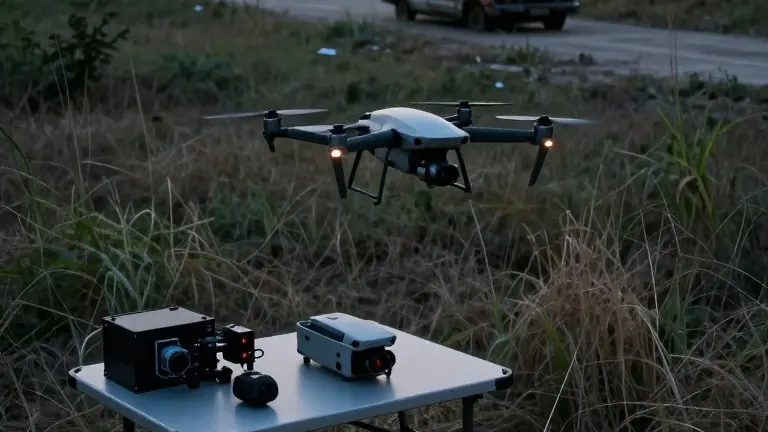
Testing for the Lupynis TFL-1 takes place in an overgrown field outside Kyiv. A team led by a man using the call sign Stab conducts daily evaluations. Stab is the head of the test and integration team. The location is kept secret for security reasons. In one demonstration, a pilot using the call sign Professor guided the drone with a control stick. He selected a dilapidated car as a target and checked a video monitor.
Upon seeing a red flash, Stab confirmed the drone had locked onto the target. Professor released the control stick, and the drone flew itself to the car. The microcomputer inside the drone ran algorithms to maintain its course. Stab noted that the pilot was doing nothing while the drone performed the task autonomously. On the battlefield, the drone would carry an explosive payload to hit the vehicle. The test drone used in the demonstration did not have one.
Stab said AI drones are useful because they are difficult to jam. He insisted that safeguards prevent the drones from going rogue. Humans still select the target before the autonomous phase begins. Russia is also deploying AI-enabled drones against Ukraine. President Volodymyr Zelenskyy has warned that AI could lead battlefield decisions as soon as next year. This development is part of a high-tech arms race that has raised concerns among military leaders.
Azhnyuk acknowledged the concerns over destructive weapons but said the issue is not unique to AI. He compared the tool to fire or steel, stating that any tool can be used for good or bad. He emphasized that humans ultimately decide how to use the tool. He described his company's drones as calculators rather than killer robots. He argued they are no more likely to cause a Terminator-style uprising than a warehouse full of artillery shells.
Azhnyuk noted that AI is developing quickly. He said it is not unthinkable that future drones will make their own decisions on designating targets. For now, his focus is on the immediate needs of the Ukrainian defense. He stated that adversaries are using the same technologies. If they use AI for offensive decision-making and Ukraine refuses to use it for defensive decision-making, Ukraine has lost. He explained that AI systems can make decisions in microseconds, while human control takes minutes, hours, or days.
Azhnyuk said that if Ukraine loses the war, there will be no way to argue about the ethics of AI. He stated that the most important thing is survival. The company continues to test its systems daily to ensure they meet the demands of the ongoing conflict.
Source: Central Florida Public Media