
Arab parties hold the keys to Israel's next government after a split vote
Initial counts show no bloc has the 61 seats needed to rule, forcing complex coalition talks involving Arab-led parties and centrist groups.
By Leila Saeed ·
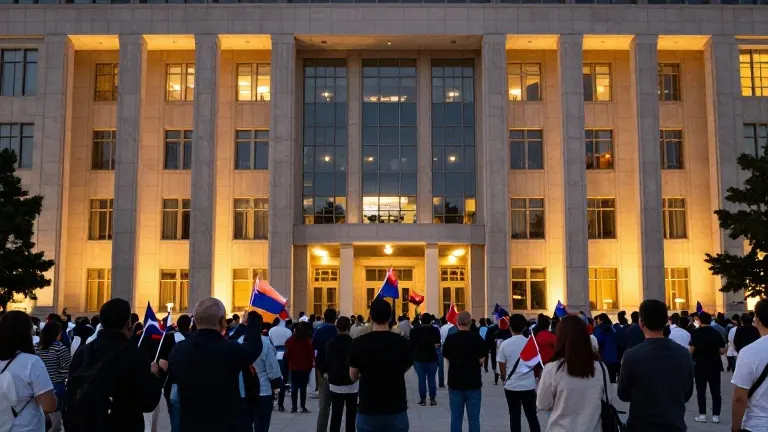
Israeli voters cast ballots on October 27, but no candidate secured a clear path to power by the following day. The Central Elections Committee's initial count indicates that Prime Minister Benjamin Netanyahu's bloc holds 54 seats, while the opposition coalition led by Gadi Eisenkot commands 50. Neither group reached the 61 seats required to form a government in the 120-member Knesset.
The race is extremely close. Four exit polls published on election night produced varied results. Kan 11 and Channel 13 projected a 51-51 tie between the two main blocs. Channel 12 gave Netanyahu a narrow edge with 52 seats against Eisenkot's 49. Channel 15 offered the most favorable projection for the incumbent, counting 55 seats for Netanyahu and 49 for Eisenkot.
The arithmetic of the Knesset requires a coalition partner for either side to rule. The Arab-led Ra'am and Joint List parties are projected to win between 16 and 19 seats combined. These parties hold the balance of power, yet political barriers remain high. Netanyahu has described a coalition with Arab parties as shameful, while key figures in the Jewish-led opposition have also ruled out such an arrangement.
Netanyahu's bloc includes Likud, the ultra-Orthodox Shas and United Torah Judaism, and the far-right Religious Zionism and Otzma Yehudit parties. Eisenkot's bloc comprises his Yashar party, the Together list linked to former prime ministers Naftali Bennett and Yair Lapid, Avigdor Liberman's Yisrael Beytenu, and Yair Golan's Democrats.
Once the president certifies the results, they will grant a mandate to the lawmaker considered most likely to assemble a majority. That individual will have 28 days to form a government, with a possible 14-day extension. If negotiations fail, another lawmaker may attempt to build a coalition. If all attempts collapse, Israel may return to the polls, a scenario that occurred repeatedly between 2019 and 2022.
Netanyahu, who has served as prime minister for 19 years across three stints, remains in a caretaker role during the transition. He continues to face corruption trials that he denies. The official certification of results is scheduled for November 4, though coalition talks may extend beyond that date.
Source: Al Jazeera