Serbian students force snap election after two-year occupation
A leaderless movement built on direct democracy has challenged President Vucic's 14-year rule, now facing the test of governing a complex geopolitical economy.
By Leila Saeed ·
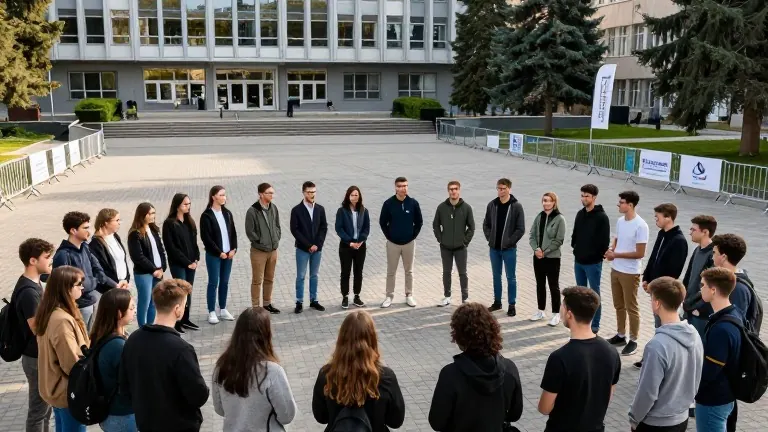
Sixteen people died in a train canopy collapse at a newly renovated station in 2024, an incident that triggered a nationwide student movement in Serbia. On Sunday, that movement delivered an electoral shock to President Aleksandar Vucic, a result opposition parties had failed to achieve for more than a decade. Until the results emerged, international media largely ignored the students, viewing them as naive youth. That underestimation by the global community and Vucic's administration may have aided their cause, but the students also built a distinct alternative model of politics over two years.
The movement’s roots extended beyond the train accident, driven by families squeezed by local corruption and international corporations offering low-wage jobs with limited mobility. Unlike previous protests, this group remained independent, refusing alignment with domestic parties or the four major powers: Russia, China, the European Union, and the United States. They avoided established opposition parties, which are often small, centralized, and vulnerable to corruption in a country dependent on foreign credit. Instead, the students created their own political scene across the country.
Protesters blockaded and occupied universities, halting higher education. They filled public squares with peaceful demonstrations and vigils. At the Faculty of Technical Sciences in Novi Sad, the largest university department with over 16,000 students, the author observed a transformed campus in March 2025. Student guards controlled entrances with metal fencing and communication equipment. LED screens in corridors announced alternative lectures. Rooms stocked food sorted by type and medical supplies tended by student nurses. Kitchens, reading rooms, and a student-run administration operated within the building.
Discussions on political and economic issues involved 300 to 400 students and lasted five or six hours. These topics later entered the movement's electoral program. This organization, centered on student plenaries, earned public respect and helped withstand police eviction attempts. As government repression increased, students called for citizens’ assemblies in March 2025 to seek justice for the 16 killed. They then made their first public demand for snap elections.
The electoral approach mirrored the protest strategy: independent, transparent, and democratic. Decisions were made collectively. The students chose academics and activists to debate public figures, ensuring equal gender distribution and regional representation. They rejected established politicians, viewing leadership-based politics as failing across Europe. Candidates were selected through interviews with students. In one session near Novi Sad last summer, a group of 300 students questioned each candidate while phones remained outside.
The Student List has begun negotiations to form the government. The first test involves its electoral program, which condemns the genocide in Gaza and rejects complicity. Under Vucic, Serbian-Israeli relations strengthened. Arms exports to Israel jumped from $3.3 million in 2023 to $126 million in 2025. In September, Vucic opened a factory for Israeli drone production. If the new government follows its platform, it must halt these arms exports. This move would extend political change into the economic sphere, challenging Serbia's place in the geopolitical order.
Such a shift could provoke resistance from domestic vested interests and foreign partners. In the final days of the campaign, US-based conservative influencers framed support for Vucic as a defense of Christian identity against Islamization. The Conservative Political Action Conference, a powerful US organization, is set to open a Serbian chapter in November, with Vucic expected to play a central role. Any shift in Serbia's ties to superpowers will test the Student List's ability to survive as a governing force and manage internal tensions.
Europe is facing similar student movements in Belgium, France, Italy, and Spain. The Serbian case offers a completed political experiment for a continent dealing with increasing economic strain. The Student List’s success demonstrates a leaderless, network-based approach to governance. The new government must now translate this model into policy while navigating complex relationships with global powers.
Source: Al Jazeera