The 25-Year Legacy of the iPod: How a $399 Gadget Reshaped the Portable Music Market
A quarter-century after its launch, the original iPod remains a pivotal moment in tech history, proving that storage capacity and seamless software integration could conquer a fragmented market.
By Ricardo Kovalenko ·
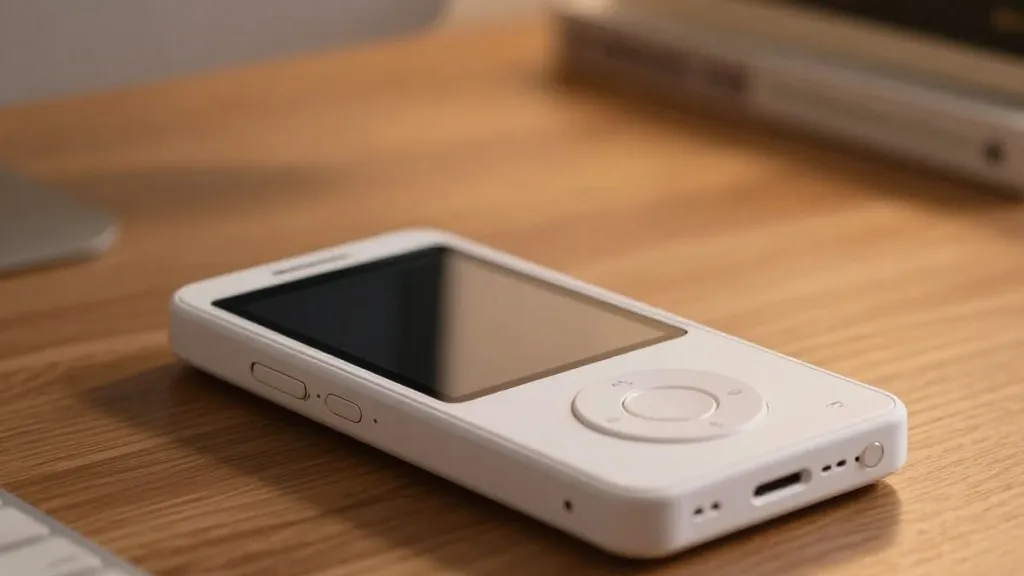
Marking the 25th anniversary of its debut, the original Apple iPod stands as a definitive turning point in consumer electronics. On October 23, 2001, Steve Jobs unveiled the device to an audience that had just watched Apple stabilize its fortunes following the dot-com bubble burst. While the market was already saturated with portable digital music players from established giants like Sony and smaller firms such as Creative and Sonic Blue, Jobs argued that none had yet found the correct formula for digital music. This announcement did not merely introduce a new gadget; it signaled Apple’s strategic expansion beyond the desktop, positioning the company to dominate the emerging sector of personal digital entertainment.
The commercial impact of the launch was immediate, driven by a specific value proposition that competitors had failed to articulate. The device was priced at $399, a cost point that Jobs justified by highlighting its storage capacity. With five gigabytes of hard disk storage, the player could hold approximately 1,000 songs. To put this in perspective for the audience, Jobs specified that this equated to 1,000 typical pop songs encoded as 160Kbps MP3s. For the average consumer, this capacity represented their entire music library, a claim that distinguished the iPod from the flash-based players of the era, which offered significantly less space for the same price.
The physical design of the device was central to its appeal, leveraging specific hardware innovations to achieve a form factor that was both novel and practical. The iPod measured 2.4 by 4 by 0.78 inches and weighed just 6.5 ounces, making it lighter than most cell phones of the time. This compactness was achieved through the use of a Toshiba 1.8-inch hard drive that was only 0.2 inches thick. Jobs emphasized that the device was the size of a deck of cards, a tangible comparison that helped consumers visualize the portability of the product. The minimalist aesthetic, featuring durable backs and sides, was marketed as an extension of Apple’s legendary ease of use, moving away from the complex interfaces of rival devices.
Beyond aesthetics, the technical specifications addressed specific pain points in the user experience. A key differentiator was the inclusion of FireWire 400 connectivity, which Apple promoted as the first and only music player to feature the technology. This connection allowed for rapid data transfer; Jobs claimed that an entire CD could be transferred to the device in five to 10 seconds. In contrast, the USB connections standard at the time took roughly five minutes to transfer the same amount of data. For a full library of 1,000 songs, the estimated transfer time was 10 minutes via FireWire, compared to five hours via USB. Additionally, the device featured a rechargeable lithium-polymer battery capable of 10 hours of continuous playback, with an 80% recharge achievable in one hour.
The software ecosystem played an equally critical role in the device's success. The launch coincided with the release of iTunes 2, which introduced features like MP3 CD burning and, crucially, Auto-Sync. This feature ensured that the curated music libraries on a user's Mac were automatically synchronized with the iPod whenever the device was connected for charging or transfer. The integration of hardware and software created a seamless workflow that competitors, who often relied on manual file management, struggled to replicate. The device also functioned as a standard FireWire hard disk drive, offering utility beyond music playback.
The user interface was designed for one-handed operation, featuring a scroll wheel with a piezoelectric clicker for tactile feedback. This allowed for quick navigation by playlist, artist, or song. During the unveiling, Jobs demonstrated the interface by playing 'Building a Mystery' by Sarah MacLachlan. The combination of high-speed syncing, substantial storage, and intuitive controls addressed the core frustrations of early digital music adoption, establishing a new standard for portable media devices.
The long-term impact of this launch extended well beyond the initial release. Although the iPhone, which debuted in early 2007, eventually subsumed the iPod's functions, the two products coexisted for over a decade. The iPod line continued to evolve, with the final model, the 7th-generation iPod Touch, released in May 2019. However, the product line was officially discontinued in May 2022, leaving it unmaintained for three years prior to that announcement. The 25-year mark serves as a reminder that the iPod was not just a music player, but a catalyst that defined how consumers interacted with digital media in the early 21st century.
In retrospect, the success of the original iPod was less about the hardware specifications alone and more about the holistic experience it provided. By identifying the hard disk-based player as the optimal market entry point and pairing it with intuitive software, Apple carved out a niche that larger competitors had overlooked. The device’s legacy is cemented not only in its sales figures but in its role as the prototype for the modern smartphone ecosystem, proving that a dedicated device could capture a market by solving specific user needs with precision and style.
Source: Tom's Hardware · original report published